We’re used to his lies. We’re used to his laziness. We’re used to his narcissism. We’re used to his corruption. But his absolute stupidity still has the power to take our breath away.
No Cure for Stupidity
The Flag-Molester-in-Chief is unable to grasp basic facts he's been told repeatedly
According to the recent book A Very Stable Genius, by Philip Rucker and Carol Leonnig of the Washington Post, former White House Communications Director Anthony “The Mooch” Scaramucci once asked Trump if he was just an act and Trump replied: “I’m a total act and I don’t understand why people don’t get it.”
The act continued Saturday, even after the first US death from coronavirus, when Trump went to CPAC. As Slate reported:
At the end of his speech, Trump decided to lovingly caress and kiss the American flag that was on stage while mouthing the words, “I love you, baby.”
On Monday, even as the US death toll rose to six, the act continued at Trump’s rally in North Carolina, where, among other things, he invited YouTube-bloggers-turned-Fox-Nation-hosts Diamond and Silk to the stage and smiled broadly as they did a bit mocking Mike Bloomberg’s height.
Presidential “performances” like these would be bad enough even if the country wasn’t in the midst of a public health crisis that has already been made worse by Trump’s rank incompetence. But the fact is, most people are no longer surprised by Trump’s nonsense.
The One Way He Still Surprises Us.
Trump has been President for more than three years. We’re used to his lies. We’re used to his laziness. We’re used to his narcissism. We’re used to his corruption. But his absolute stupidity still has the power to take our breath away.
Here he is yesterday, before the rally, asking pharmaceutical executives if the proposed coronavirus vaccine could also make a sick person “better, quicker.”
Just to underline the point: We are in the third month of the Coronavirus crisis and Trump still doesn’t understand how vaccines work.
And it gets worse.
By now, almost every cognizant being in America is aware that the timeline for developing, testing, manufacturing and distributing an effective vaccine for COVID-19 will be at least a year.
Except the President.
During the meeting, Trump repeatedly pressed executives to have a vaccine ready in “couple of months” or “a few months.”
Whatever the causes of Trump’s mental deficiency, this is not the first time he’s demonstrated an inability to absorb facts that don’t match either his personal reality or what he just heard on Fox News.
Some examples:
In 2013, more than a decade after the Central Park Five (who Trump had wanted to execute) had been exonerated by DNA of the crime for which they were wrongly convicted, Trump was continuing to speak out against them—even going so far as to argue with his own parody account on Twitter about the case.
To this day, Trump still continues to recycle his claim that Hillary only beat him in the 2016 popular vote because three-to-five million people voted illegally. That’s after his own voter fraud commission ruled that the conspiracy theory had no basis in fact.
And in the midst of the current coronavirus crisis, Trump stood at the White House podium just last week and told us “nobody knew” that thousands of people died from the flu every year. This one is particularly scary in light of the fact that 4,000 Americans were dying every week at the height of his first flu season, a death toll that potentially included thousands of deaths caused by his own incompetence.
Maybe he was just born stupid. Maybe there’s a medical reason. But Trump’s inability to process and retain new information is becoming a clear and present handicap for a President who will be called upon to make quick decisions during this fast-moving crisis—and others still to come.
The great fathers who founded our nation always referred to debt dependence as a way of stealing from our future generations. For several years, the United States has depended on debt and in 2020; the US is on its way to hit a new record of about $2 trillion dollar in deficit.
This reliance on debt is almost getting out of control not to mention that we will have great trouble if the price of oil hikes.
We are in trouble because the stock market rise is almost becoming unsustainable since the rise has been fueled by continuous pumping of cash into the markets by the Federal Reserve.
If a war erupts with Iran, the Federal Reserve will not be able to finance a war and pump money to the stock market at the same time.
Too many things are at stake at this point a major stock market crash will have to happen.
America is certainly not in an economic collapse now and most likely, the nation may not avoid big economic meltdown for long since the indicators that the nation might find itself in economic collapse are rising exponentially.
The global investors in the bond market are sending a clear message; since the end of July, the long term interest rates have plunged and history has proven that this often precedes decline in economic growth, interest rates reduction by the Federal Reserve.
If key policies are not enacted at this stage, things may get out of hands resulting in a financial collapse and stock market crash.
The Federal Reserve has already pumped $3 trillion dollar into the markets and they are planning to pump more $2.8 trillion dollar.
They are also buying treasuries worth about $60 billion every month.
This indicates that the economic depression has already begun biting and any time, the bubble will burst and it will be obvious that an economic collapse has begun.
However, any time a collapse is about to occur, the elites in the federal reserve always use existing crisis events or even intentionally trigger some events to distract the public attention. Usually, collapse is a process that is difficult for people to notice until it is too late.
Everyone will realize that things are out of control the day we will wake up and realize that the dollar has already lost 50% of its value or if we find out that major exporting countries have rejected the dollar as global payment currency.
There is no limit in the amount of dollars that can be printed and this time around, it will become almost impossible to avoid the dollar collapse. It is not a surprise that most central banks prefer gold over the dollar.
In conclusion, we have a rigged economic model made up of fiat money, poor growth and inefficient policies.
In this condition, it will not take long to find ourselves in a biting economic collapse than what we had back in 2008.
It is clear that a major economic collapse is on the way and we have to be prepared and remain vigilant for any signs of extreme imbalance either in the stock market or the housing market since the things discussed can easily trigger a financial collapse in America.
The system is already broken in many ways and it is crumbling under its weight.
The world is driven by nature’s law and only humans think that they can defy the force of gravity.
From history, we have learned the hard way multiple times that greed always leads to a disastrous ending.
There is a very high chance that the worst economic collapse might happen in 2020. However, even if it does not happen, we should not feel safe because all signs signify that it will happen very soon.
We may not know the exact date but we have all the signs so it is wise that we prepare for the worst.
2018 marks the 200th anniversary of the birth of German philosopher and Communist icon Karl Marx. Is Karl Marx still relevant in the 21st century? Philosopher, historian and economist Karl Marx is a name that’s back on everyone's lips. The documentary explores the ongoing impact of his writings in Europe and China. How should we approach the legacy of someone who - like few others before or since - not only changed the world, but divided it as well? Even though not everyone accepts his ideas, Marx's analyses and theories motivated many people to take political action. We meet activists, witnesses and experts - individuals who are able to illuminate Karl Marx's impact from the Russian revolution until today. Even in the 21st century, two hundred years after his birth, Marx has lost none of his relevance. After the fall of the Iron Curtain in Europe and the end of the Cold War in 1989 and 1990, the sun seemed to be setting on Marx. But during the financial crisis of 2007-2008, when the contradictions of capitalism were once more laid bare, Marx was resurrected as an icon. His theories and ideas are now enjoying something of a renaissance at universities, churches, and conferences, and in mainstream broadcast and print media. The Chinese have even donated a larger-than-life statue of Marx to the city of his birth, Trier. This thought-provoking documentary does not shy away from controversy. As well providing insight into Karl Marx’s life and work, it investigates what appealed to past and present advocates of his philosophies, bringing the story to life with a rich trove of archive material.
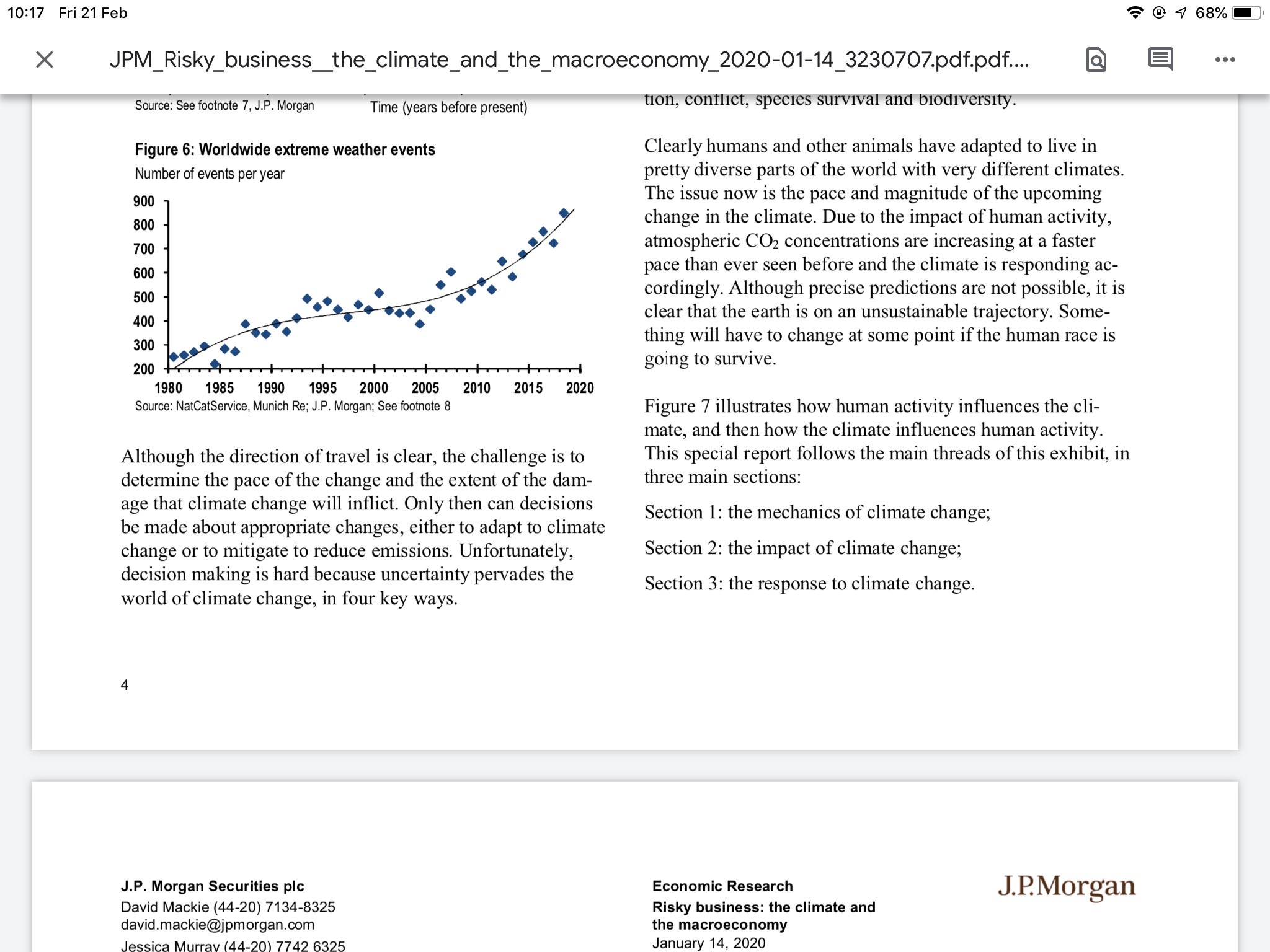
Here’s a screenshot of the most astonishing & distressing page from the private JP Morgan report that I have been able to help leak. “[It] is clear that the earth is on an unsustainable trajectory. Something will have to change at some point if the human race is going to survive”
If this trajectory graph is since 1980 only, it’s pretty clear that as a species, we are in very real trouble.
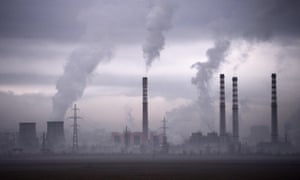
The JP Morgan paper said ‘catastrophic outcomes’ could not be ruled out. Photograph: Dimitar Dilkoff/AFP via Getty Images
The world’s largest financier of fossil fuels has warned clients that the climate crisis threatens the survival of humanity and that the planet is on an unsustainable trajectory, according to a leaked document.
The JP Morgan report on the economic risks of human-caused global heating said climate policy had to change or else the world faced irreversible consequences.
The study implicitly condemns the US bank’s own investment strategy and highlights growing concerns among major Wall Street institutions about the financial and reputational risks of continued funding of carbon-intensive industries, such as oil and gas.
JP Morgan has provided $75bn (£61bn) in financial services to the companies most aggressively expanding in sectors such as fracking and Arctic oil and gas exploration since the Paris agreement, according to analysis compiled for the Guardian last year. Advertisement
Its report was obtained by Rupert Read, an Extinction Rebellion spokesperson and philosophy academic at the University of East Anglia, and has been seen by the Guardian.
The research by JP Morgan economists David Mackie and Jessica Murray says the climate crisis will impact the world economy, human health, water stress, migration and the survival of other species on Earth.
“We cannot rule out catastrophic outcomes where human life as we know it is threatened,” notes the paper, which is dated 14 January.
Drawing on extensive academic literature and forecasts by the International Monetary Fund and the UN Intergovernmental Panel on Climate Change (IPCC), the paper notes that global heating is on course to hit 3.5C above pre-industrial levels by the end of the century. It says most estimates of the likely economic and health costs are far too small because they fail to account for the loss of wealth, the discount rate and the possibility of increased natural disasters.
Sign up to the Green Light email to get the planet's most important stories
Read more
The authors say policymakers need to change direction because a business-as-usual climate policy “would likely push the earth to a place that we haven’t seen for many millions of years”, with outcomes that might be impossible to reverse.
“Although precise predictions are not possible, it is clear that the Earth is on an unsustainable trajectory. Something will have to change at some point if the human race is going to survive.”
The investment bank says climate change “reflects a global market failure in the sense that producers and consumers of CO2 emissions do not pay for the climate damage that results.” To reverse this, it highlights the need for a global carbon tax but cautions that it is “not going to happen anytime soon” because of concerns about jobs and competitiveness.
The authors say it is “likely the [climate] situation will continue to deteriorate, possibly more so than in any of the IPCC’s scenarios”.
Without naming any organisation, the authors say changes are occurring at the micro level, involving shifts in behaviour by individuals, companies and investors, but this is unlikely to be enough without the involvement of the fiscal and financial authorities.
Last year, analysis compiled for the Guardian by Rainforest Action Network, a US-based environmental organisation, found JP Morgan was one of 33 powerful financial institutions to have provided an estimated total of $1.9tn (£1.47tn) to the fossil fuel sector between 2016 and 2018.
A JP Morgan spokesperson told the BBC the research team was “wholly independent from the company as a whole, and not a commentary on it”, but declined to comment further. The metadata on the pdf of the report obtained by Read said the document was created on 13 January and that the author of the file was Gabriel de Kock, executive director of JP Morgan. The Guardian has approached the investment bank for comment.
Pressure from student strikers, activist shareholders and divestment campaigners has prompted several major institutions to claim they will make the climate more of a priority. The business model of fossil fuel companies is also weakening as wind and solar become more competitive. Earlier this month, the influential merchant bank Goldman Sachs downgraded ExxonMobil from a “neutral” to a “sell” position. In January, BlackRock – the world’s biggest asset manager – said it would lower its exposure to fossil fuels ahead of a “significant reallocation of capital”.
Environmental groups remain wary because huge sums are invested in petrochemical firms, but some veteran financial analysts say the tide is changing. The CNBC money pundit Jim Cramer shocked many in his field when he declared: “I’m done with fossil fuels. They’re done. They’re just done.”
Describing how a new generation of pension fund managers was withdrawing support, he claimed oil and gas firms were in the death knell phase. “The world has turned on them. It’s actually happening kind of quickly. You’re seeing divestiture by a lot of different funds. It’s going to be a parade that says, ‘Look, these are tobacco. And we’re not going to own them,’” he said. “We’re in a new world.”
Global Empowerment Meeting (GEM18), April 17-18, 2018 Keynote Session: The Road to Unfreedom: How our Intuitive Sense of Us and Them Makes us Vulnerable to Tyranny The world seems to be in a path of de-democratization. But this is not the first but the third time this happens. What can be learned from previous experiences? What are the connections between today’s authoritarianism and those of the past? Does democracy require shared factuality -a shared understanding of the facts of objective reality within epistemic communities - and is this now being challenged? Are these epistemic communities breaking down? If so, what are the fault lines of that breakdown? Are new technologies making us more vulnerable to psychological manipulation relative to the propaganda of previous decades? And how does this manipulation work? Speaker: Timothy Snyder, Richard C. Levin Professor of History at Yale University and Permanent Fellow at the Institute of Human Sciences in Vienna Category Education